

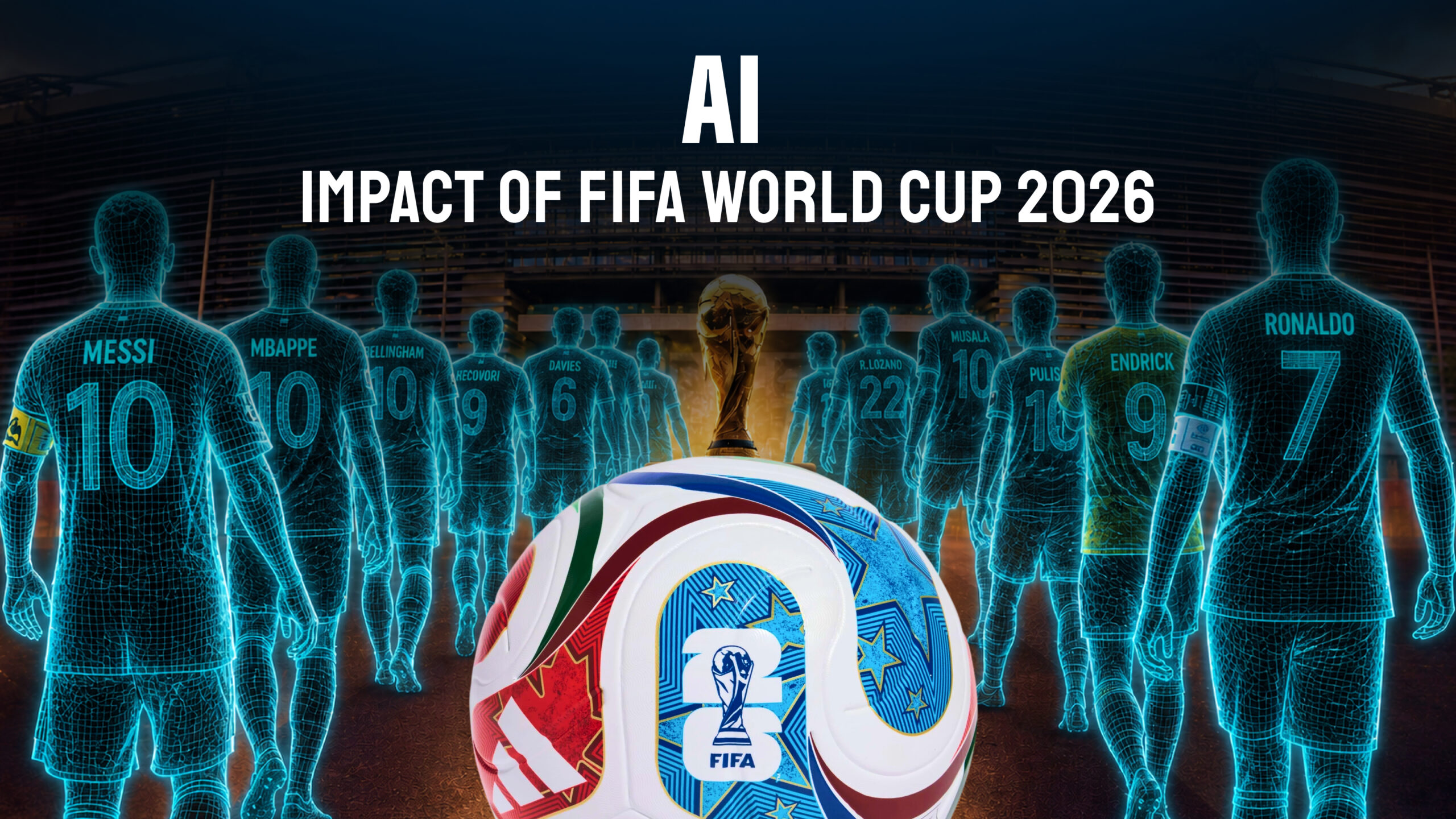
The FIFA World Cup 2026 represents a major shift in how football is managed, analyzed, and experienced. Artificial intelligence now sits at the core of the game, especially through advanced computer vision systems that track player movements with high precision.
A network of high-speed cameras is placed around the stadium to continuously monitor every player on the pitch. These cameras capture positional data from multiple angles, allowing AI models to identify each player, track their movement, and calculate their exact location in real time. AI converts this visual input into structured data, translating each movement into coordinates, speed, acceleration, and direction.
Over the course of a match, this creates a detailed digital representation of the game, where every movement is recorded and analyzed.
3D Player Modeling and Movement Accuracy
One of the most important developments in 2026 is the use of 3D player modeling. Before the tournament, players are scanned to create accurate digital representations of their bodies. These models allow AI systems to recognize players even in complex situations, such as crowded penalty areas or high-speed transitions.
The system can track not just where a player is, but which part of their body is in motion. This level of detail improves accuracy in situations where small positional differences matter, especially in tight decision-making scenarios.
Semi-Automated Offside Decisions
Semi-automated offside technology is one of the clearest applications of AI vision. The system combines player tracking with ball data to determine the exact moment a pass is made and the precise position of each player at that instant.
Instead of relying on manual judgment, AI calculates the offside line automatically using real-time positional data. This reduces decision time and improves consistency while still allowing referees to make the final call.
Smart Ball Integration and Event Timing
The connected match ball adds another layer of precision. It contains sensors that send data multiple times per second, allowing the system to detect the exact moment of contact between a player and the ball.
When this data is synchronized with player movement tracking, it creates a complete timeline of events. This helps determine not only where players are positioned, but also when key actions occur. The result is more accurate decisions in situations where timing is critical.
Tactical Insights and Performance Analysis
AI-driven movement tracking is also transforming how teams approach the game. Coaches and analysts can study detailed movement patterns, including how players position themselves, create space, and respond to pressure.
This data helps teams understand defensive structure, attacking movement, and overall team coordination. Instead of relying only on observation, decisions are supported by measurable patterns and real-time insights.
Conclusion
The FIFA World Cup 2026 highlights how AI is reshaping football through advanced vision systems and precise movement tracking. Every action on the pitch is captured and analyzed, creating a deeper understanding of the game.
While the core of football remains unchanged, the way it is observed, managed, and interpreted has evolved significantly. AI is not replacing the human element but enhancing it with accuracy, speed, and data-driven insights.