
Technology has completely transformed the way people live, work, and communicate. Among the most powerful innovations shaping today’s digital world are Artificial Intelligence (AI) and Machine Learning (ML). Although these terms are often used together, many people still misunderstand their actual meaning.
While both technologies are closely connected, they are not the same.
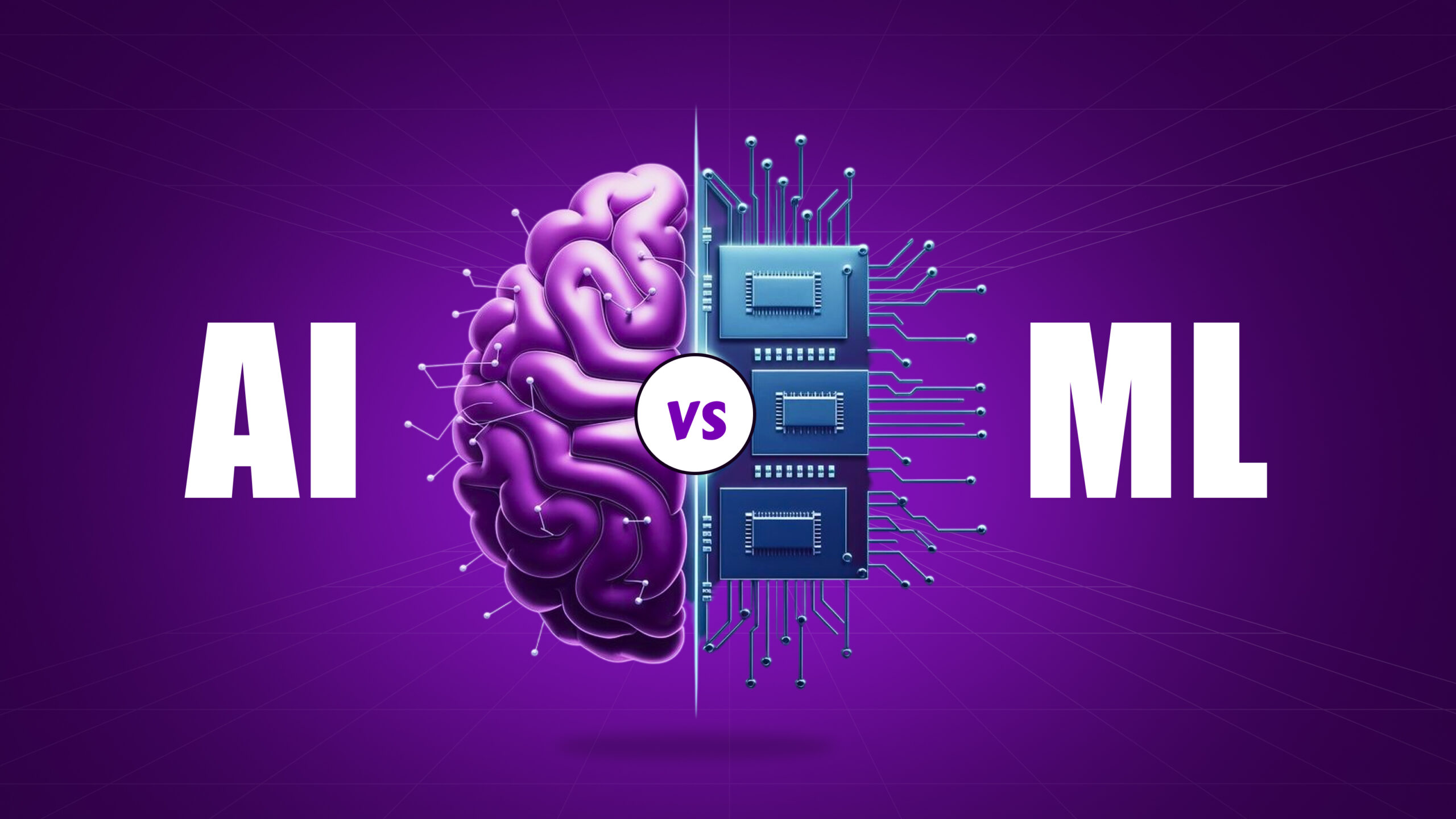
Artificial Intelligence focuses on creating smart systems that can perform tasks similar to human intelligence, whereas Machine Learning enables systems to learn from data and improve automatically over time.
Understanding the difference between AI and ML helps businesses, students, and professionals make informed decisions in today’s technology-driven environment.
What is Artificial Intelligence (AI)?
Artificial Intelligence (AI) refers to the ability of machines or computer systems to mimic human intelligence. AI-powered systems can perform tasks such as:
- Problem-solving
- Decision-making
- Language understanding
- Speech recognition
- Visual recognition
- Data analysis
The primary goal of AI is to develop machines that can think, analyze, and respond intelligently with minimal human intervention.
Today, AI technology is widely used across industries, including healthcare, customer service, e-commerce, education, and transportation, through advanced AI development services designed to improve automation and efficiency.
Popular Examples of AI
- Virtual assistants like Siri and Alexa
- AI chatbots for customer support
- Recommendation systems on Netflix and YouTube
- AI-powered medical diagnosis systems
- Smart home automation devices
- Self-driving vehicle technology
AI systems help businesses automate operations, reduce human effort, improve efficiency, and enhance accuracy.
What is Machine Learning (ML)?
Machine Learning (ML) is a subset of Artificial Intelligence that focuses on enabling machines to learn from data without being explicitly programmed for every task.
Instead of relying on fixed instructions, Machine Learning systems identify patterns in data, learn from previous experiences, and continuously improve their performance with the help of scalable Machine Learning solutions for modern businesses.
Large amounts of data are processed to generate predictions, insights, and automated decisions.
Common Applications of Machine Learning
- Spam email filtering
- Fraud detection systems
- Search engine algorithms
- Social media content recommendations
- Online shopping suggestions
- Predictive analytics
Data plays a crucial role in Machine Learning because the quality and quantity of data directly impact the accuracy of predictions.
AI vs Machine Learning: The Main Difference
The biggest difference between Artificial Intelligence and Machine Learning lies in their purpose and functionality.
- Artificial Intelligence aims to create intelligent systems capable of simulating human thinking and behavior.
- Machine Learning focuses on teaching machines how to learn from data and improve automatically.
In Simple Terms:
- AI is the broader concept
- ML is a subset of AI
AI systems may use Machine Learning, but not all AI systems depend entirely on ML.
Key Differences Between AI and Machine Learning
| Artificial Intelligence (AI) | Machine Learning (ML) |
|---|---|
| Focuses on creating smart machines | Focuses on learning from data |
| Mimics human intelligence | Improves performance through learning |
| Includes reasoning and decision-making | Mainly relies on algorithms and datasets |
| Broader field of technology | Subset of AI |
| Used in automation, robotics, and assistants | Used in predictions, analytics, and recommendations |
Benefits of Artificial Intelligence
Artificial Intelligence offers several advantages that help businesses improve productivity and operational efficiency.
1. Faster Decision-Making
AI systems can process and analyze massive amounts of data quickly, enabling smarter and faster business decisions.
2. Improved Customer Experience
AI chatbots and virtual assistants provide instant responses and personalized support to customers.
3. Reduced Human Error
Tasks that require high accuracy can be performed with fewer mistakes using AI-powered systems.
4. Automation of Repetitive Tasks
Routine and time-consuming activities can be automated, saving both time and effort.
5. 24/7 Availability
AI systems can operate continuously without breaks, ensuring uninterrupted support and services.
Benefits of Machine Learning
Machine Learning provides businesses and users with powerful data-driven advantages.
1. Better Predictions
ML models can predict future trends, customer behavior, and business outcomes more accurately.
2. Personalized User Experience
Machine Learning helps deliver personalized content, advertisements, and product recommendations.
3. Continuous Improvement
As more data becomes available, ML systems continuously improve their accuracy and efficiency.
4. Fraud Detection
Suspicious activities and unusual transaction patterns can be identified quickly using ML algorithms.
5. Efficient Data Analysis
Large datasets can be processed and analyzed efficiently to generate valuable insights.
Real-World Applications of AI and Machine Learning
AI and ML technologies are now being used across almost every major industry.
Healthcare
AI-powered systems assist in early disease detection, while Machine Learning models analyze patient data for better diagnosis and treatment planning.
Finance
Machine Learning helps detect fraudulent transactions, while AI-powered tools provide automated financial assistance and support.
E-Commerce
Online shopping platforms use AI and ML to deliver personalized product recommendations and improve customer experiences.
Education
Educational platforms use AI to create smarter learning experiences and personalized learning paths for students.
Marketing
Customer behavior and market trends are analyzed using Machine Learning, while AI tools help automate marketing campaigns and content generation.
Future of AI and Machine Learning
The future of Artificial Intelligence and Machine Learning is highly promising. As technology continues to evolve, smarter automation systems, predictive tools, and intelligent applications will become even more advanced.
Businesses across healthcare, finance, e-commerce, and marketing industries are now investing in AI & ML integration services to improve operational efficiency and customer engagement.
In the coming years, AI and ML are expected to transform industries such as:
- Healthcare
- Education
- Cybersecurity
- Transportation
- Digital Marketing
- Finance
- Retail
These technologies will continue shaping the future of business and everyday life.
Conclusion
Artificial Intelligence and Machine Learning are revolutionizing the modern digital landscape. Although both technologies are closely connected, they serve different purposes.
- Artificial Intelligence focuses on building intelligent systems capable of simulating human behavior.
- Machine Learning enables systems to learn from data and improve automatically over time.
Explore our advanced Artificial Intelligence and Machine Learning Services to build smarter, scalable, and future-ready digital solutions for your business.
As innovation continues to accelerate, AI and Machine Learning will play an increasingly important role in driving business growth, automation, and smarter digital experiences.