
If your Shopify or WooCommerce store is starting to feel the strain of growth, slower page loads, clunky checkout customizations, or a storefront that just can’t keep up with your marketing team’s ideas, you’re not alone. Thousands of fast-growing eCommerce brands hit the same wall, and more of them are solving it the same way: headless commerce.
In this guide, we’ll break down what headless commerce actually means, why it matters for Shopify and WooCommerce stores specifically, and how to know if 2026 is the right year to make the switch.
What Is Headless Commerce, Really?
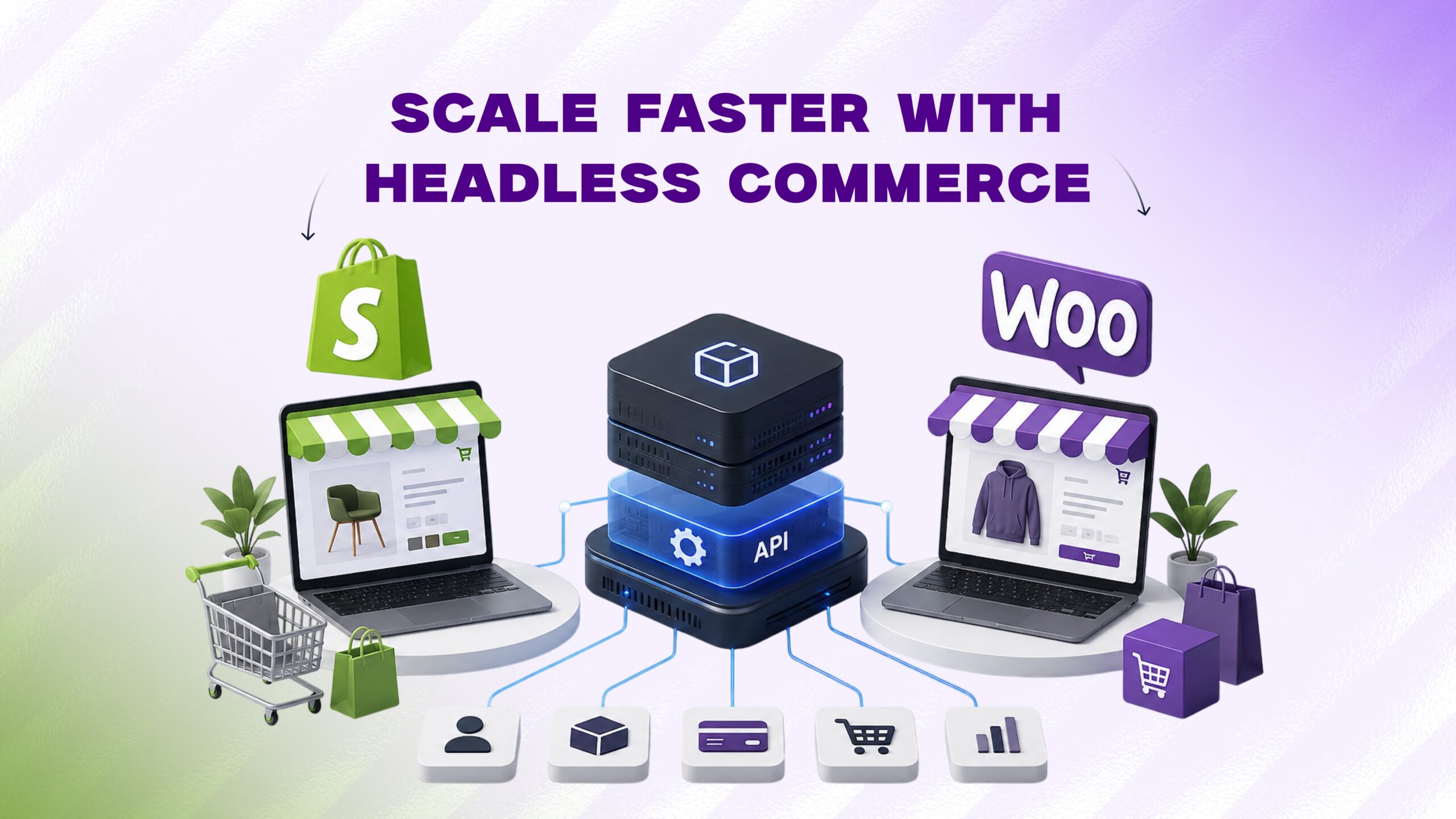
Traditional Shopify and WooCommerce setups bundle two things together: the backend (product catalog, inventory, orders, payments) and the frontend (the actual storefront your customers see and click through). That bundling is convenient early on, but it becomes a bottleneck once you want to move fast.
Headless commerce separates the two. Your Shopify or WooCommerce backend keeps handling products, orders, and payments exactly as before, but the storefront is rebuilt as an independent layer, typically using a modern framework like Next.js or React, that talks to the backend through APIs. The result is a storefront that’s no longer limited by your platform’s default theming engine.
Why Growing Stores Are Making the Switch
- Page speed becomes a competitive advantage, not an afterthought. Every extra second of load time costs conversions. A headless frontend, served through a modern framework with server-side rendering and edge caching, routinely loads faster than a traditional theme-based storefront, especially on mobile, where most shopping traffic now happens.
- You’re no longer boxed in by theme limitations. Want a completely custom product configurator, a unique checkout flow, or a landing page experience that doesn’t look like every other Shopify store? With a decoupled frontend, your design and development team can build exactly what the brand needs instead of working around a theme’s constraints.
- One backend, multiple storefronts. Headless architecture makes it realistic to run a website, a mobile app, and even in-store kiosk experiences off the same product and inventory data, a huge advantage for omnichannel brands.
- SEO gets easier to control, not harder. This is a common misconception. Done correctly (with proper server-side rendering), a headless storefront can outperform a traditional theme on Core Web Vitals, which directly influences search rankings.
- Scaling traffic spikes without breaking checkout. Flash sales and viral moments can crush a standard theme. A properly architected headless frontend, paired with a solid caching and CDN strategy, handles traffic surges far more gracefully.
Shopify vs. WooCommerce: Going Headless Looks a Bit Different
Shopify (Hydrogen / Storefront API): Shopify’s own APIs make headless implementation relatively structured, and merchants keep the platform’s payment processing, checkout security, and app ecosystem while gaining a fully custom frontend.
WooCommerce (WordPress + REST/GraphQL API): Because WooCommerce runs on WordPress, going headless usually means decoupling the storefront while keeping WordPress as a flexible, plugin-rich backend, a great option for brands with heavy content or blog-driven SEO strategies alongside their store.
Our team has built and scaled both. If you’re comparing platforms, our detailed breakdown of Shopify development services and custom WordPress & WooCommerce development covers the tradeoffs in more depth.
Is Headless Commerce Right for Your Store?
Headless isn’t for every store, and that’s an important, honest point. It generally makes sense when:
- Your store has outgrown what themes and page builders can deliver
- Page speed and Core Web Vitals are directly hurting conversion or ad performance
- Marketing needs to launch new landing pages or campaigns faster than development can currently support
- You’re planning to expand into a mobile app or multiple sales channels
- You’re managing a large, complex catalog with heavy traffic (typically 5,000+ SKUs or high-volume seasonal spikes)
If your store is still under a few thousand monthly sessions and running smoothly on a well-optimized theme, a full headless rebuild may be premature. In that case, targeted performance and UX improvements are usually a better first step.
What a Headless Migration Actually Involves
- Architecture audit, mapping current theme dependencies, apps, and integrations that need to survive the migration
- API and data layer setup, connecting your Shopify or WooCommerce backend to the new frontend via Storefront API, REST, or GraphQL
- Frontend rebuild, typically in Next.js or React, rebuilt page by page with performance and conversion in mind
- SEO preservation, careful URL mapping, redirects, and structured data so rankings aren’t lost during the switch
- Testing and phased rollout, checkout, payments, and third-party app integrations were tested thoroughly before full launch
This is a meaningful technical undertaking, which is why it’s worth partnering with a team that has handled both the eCommerce platform side and the modern frontend side. Our eCommerce development services cover everything from Shopify and WooCommerce to BigCommerce and Magento, and we pair that with hands-on experience building high-performance Next.js and React storefronts.
Real Results Matter More Than Trends
Headless commerce is a genuine architectural shift, not just a buzzword, but it should be adopted because it solves a real business problem, not because it’s trending. When we rebuilt the WooCommerce-powered storefront for Pumping Iron Store, the focus was exactly this: faster load times, smoother filtering, and a mobile-first shopping experience that translated into measurably better conversion rates.
Final Thoughts
Headless commerce gives fast-growing Shopify and WooCommerce brands the speed, flexibility, and scalability that theme-based storefronts eventually can’t provide. The key is approaching it strategically, auditing what you actually need, protecting your SEO equity, and working with a team that understands both the commerce backend and the modern frontend stack.
Thinking about going headless? Talk to eLeoRex Technologies about a free architecture assessment for your Shopify or WooCommerce store.
If you’re looking to bring something new to your business, whether that’s a headless commerce rebuild, a performance upgrade, or a complete storefront overhaul, drop us a line at manager@eleorex.com and let’s talk about what’s possible.
FAQs
Does headless commerce hurt SEO? No, when implemented correctly with server-side rendering, proper redirects, and structured data, headless storefronts often improve SEO performance through better Core Web Vitals scores.
Is headless commerce more expensive than a standard theme? The upfront investment is typically higher since it’s a custom build, but many brands see that cost offset through better conversion rates, lower bounce rates, and reduced long-term dependency on theme/app limitations.
Can I go headless without losing my existing Shopify or WooCommerce backend? Yes, that’s the core benefit. Your backend, product data, and order management stay exactly where they are; only the storefront layer changes.